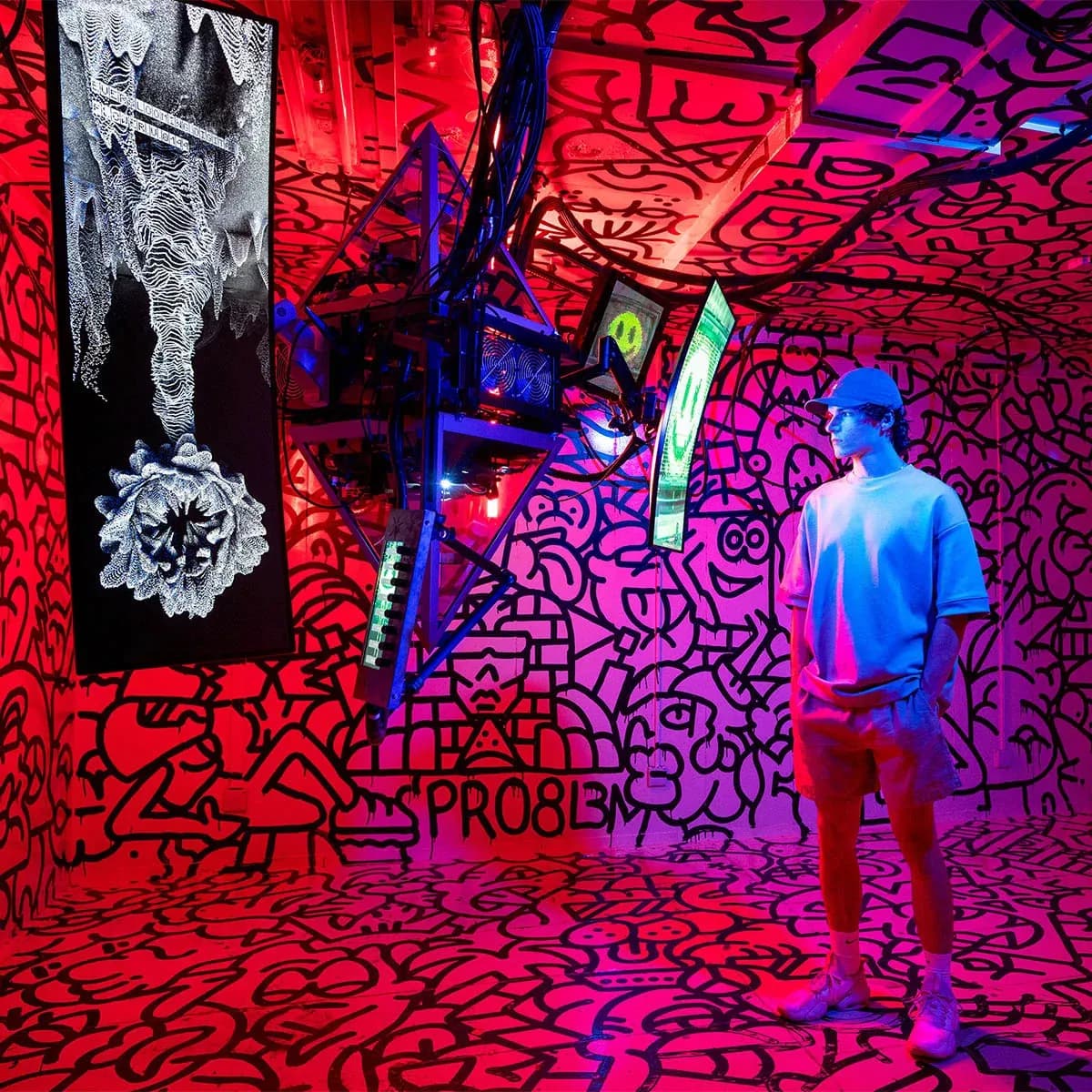
When technology disappears into the experience itself, audiences stop watching from the outside and become part of something larger.
For Kuba Matyka and Kamila Staszczyszyn, immersive art begins with a question that extends beyond technology: what should people feel when they encounter it?
The Warsaw-based creative duo behind MELT IMMERSIVE has built its practice around that idea, working where contemporary art, technology and spatial design meet. Recognised by the Financial Times' NewEurope100 ranking among the region's innovative creators, they have developed installations that move beyond conventional multimedia to surround audiences with light, sound, movement and digital environments.
Their work has travelled from Poland to international venues including Atelier Des Lumières in Paris, Ars Electronica in Austria and Lincoln Center in New York. Projects such as Moments and Turbulence have explored different ways of dissolving the boundary between artwork and observer.
Moments, inspired by impressionist painting, considers the fleeting nature of time through immersive audiovisual storytelling. Turbulence, meanwhile, explores digitally simulated particles within vast virtual environments. Across both, the physical space becomes part of the work rather than simply a setting for it.
From the gallery to an entire environment
This approach has also shaped collaborations with Polish artists including PRO8L3M, Hania Rani, Dawid Podsiadło and Sokół, as well as international acts such as Empire of the Sun, Bebe Rexha and Troye Sivan. Their work has also extended into partnerships with Disney, Netflix and Versace.
Yet the ambition of MELT IMMERSIVE is perhaps most clearly expressed in melt museum, established by Matyka and Staszczyszyn in October 2023 at Plac Powstańców Warszawy in central Warsaw.
Described as Poland's first dedicated immersive art centre, the 600-square-metre museum extends across three floors and contains 14 multisensory installations, some of them interactive. Its permanent exhibition, Artificial Dreams, examines humanity's complicated relationship with artificial intelligence, moving between techno-utopian possibilities and cyberpunk visions.
The museum also reflects the duo's ambition to make immersive art accessible beyond specialist audiences. Their stated vision is an "immersive Disneyland for all people, regardless of age", positioning the space as somewhere that can accommodate family visits, dates and more serious encounters with contemporary art.
The breadth of that intended audience is important to their wider approach. Immersion is not treated as a specialised technical experience reserved for people already familiar with digital art. Instead, the visitor's own response becomes part of the work.
Technology is the means, not the message
That distinction lies at the centre of MELT IMMERSIVE's creative philosophy.
Rather than treating technology as the main attraction, Matyka and Staszczyszyn combine light, sound, imagery, movement detection and architecture to create environments in which the visitor can become absorbed. Their understanding of immersion is therefore less about watching advanced technology operate and more about temporarily losing awareness of the world outside the experience.
Their recent work with rapper Mata illustrates this philosophy in a particularly direct way.
For the #MATA2040 stadium tour, MELT IMMERSIVE used real-time deepfake technology to place audience members' faces into an experience featuring Mata's face on stadium screens. The project received 11 awards at KTR 2026, including Best of Technology.
The scale of the project brought an advanced and often debated technology into a live setting where the audience itself became part of the experience. Recordings generated nearly five million views, while audience reactions described in the supplied material centred on excitement rather than anxiety about artificial intelligence.
For Kamila Staszczyszyn, the technology itself was not the essential achievement. As she put it: "Technology was the tool, but what mattered was what people felt seeing themselves on screen."
That statement provides perhaps the clearest insight into the thinking behind MELT IMMERSIVE. The technology can change, become more sophisticated and open new possibilities, but the creative purpose remains human.
Building immersive experiences together
The work also depends on collaboration across disciplines. Composer Wojciech Urbański, from RYSY, created the soundtrack for melt museum, while NVIDIA provides technological partnership.
That collaborative model reflects the way MELT IMMERSIVE approaches spatial experience. No single medium is expected to carry the work alone. Sound, image, architecture, movement and technology are brought together to create a unified environment.
From international installations to a permanent museum in Warsaw and the use of real-time deepfake technology in a stadium setting, the trajectory of MELT IMMERSIVE reflects a broader ambition: to treat immersive experience as an artistic practice in its own right.
At the centre of that practice, however, remains a deliberately simple principle. Technology may create the conditions for immersion, but it is the human response that gives the experience its meaning.
Visitor Information
Venue:
melt museum
Plac Powstańców Warszawy 2A, Warsaw
Opening Hours:
Tuesday–Sunday: 10.00–21.00
Tickets, Tuesday–Friday:
Normal: 49 PLN
Reduced: 39 PLN
Tickets, Saturday–Sunday / Holidays:
Normal: 59 PLN
Reduced: 49 PLN