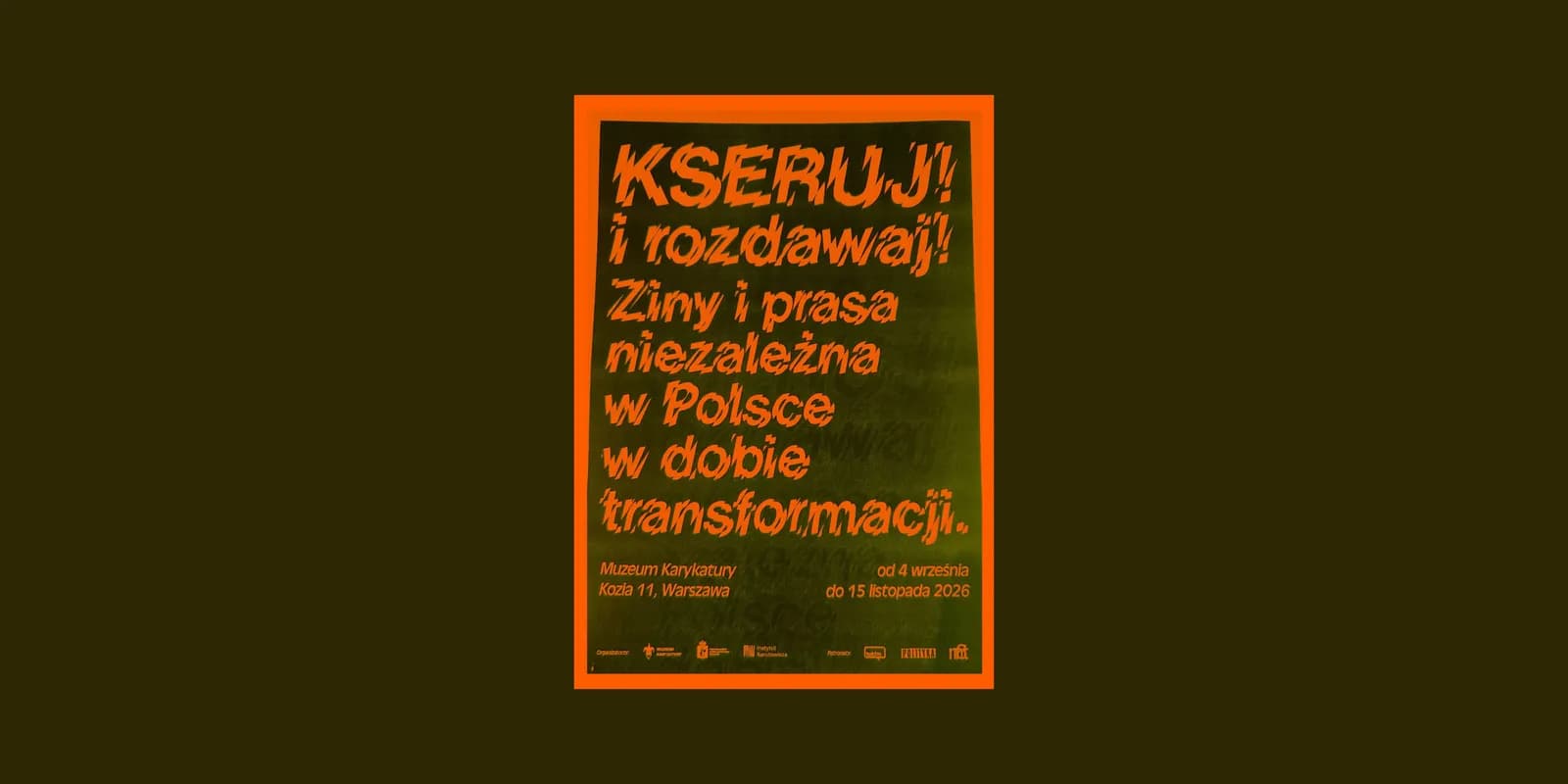
Warsaw’s Muzeum Karykatury is turning its attention to one of the most inventive forms of independent publishing in modern Poland with Kseruj i rozdawaj! Ziny i prasa niezależna w Polsce w dobie transformacji (Copy and spread! Polish zines and independent press during the transformation period).
Opening on 4 September, the exhibition brings together more than 1,000 zines and independent publications, offering a look at the people, ideas and subcultures that found a way to communicate outside the official publishing system during the 1980s and 1990s.
The exhibition opens to the public the day after its 3 September vernissage and continues until 15 November 2026.
When the photocopier became a publishing tool
Long before social media made it possible to publish instantly to thousands of people, producing an independent magazine could mean finding access to a photocopier, duplicator or basic printing equipment and then passing the finished copies from hand to hand.
For Poland's independent publishing scenes, these simple technologies offered something valuable: a way to communicate without relying on established publishers or institutions.
The resulting publications could be political, artistic, literary or simply devoted to a particular music or subculture. Their appearance was often as distinctive as their subject matter, with rough layouts, handwritten elements, unusual typography and deliberately unconventional language.
Kseruj i rozdawaj! places this material within the wider social and political changes of Poland's transformation period. The publications did not all represent the same worldview. Some supported opposition movements or challenged authority, while others reflected subcultures and communities with very different political positions.
That variety is an important part of the exhibition. Independent publishing could provide a space for emancipation and criticism, but it could also be used to circulate exclusionary or authoritarian ideas.
From Solidarity to punk, comics and football culture
The exhibition spans a remarkably broad range of Polish independent publishing.
Visitors will encounter early artistic publications such as Notatnik robotnika sztuk (Notes of an art worker), as well as political material including the underground press associated with Solidarność.
Other sections explore the publications emerging from Poland's counterculture. These include punk and anarchist zines, music publications, literary titles and comics, alongside material connected with football supporters and skinhead scenes.
Among the examples listed by the museum are Chaos w mojej głowie, Mać pariadka, Wici, Biały grom, Lampa, Ziniol and Prosiacek.
Together, they reveal how different groups used small-scale publishing to create their own communities and conversations at a time when Polish society was undergoing profound change.
A record of a changing Poland
Zines are easy to overlook when discussing the cultural history of the transformation period. They were usually produced in small numbers, distributed informally and rarely designed to last.
That makes surviving examples particularly useful today. Alongside the opinions of their creators, they preserve traces of the language, visual culture and communities of the period.
The exhibition also looks at what happened to the people behind these publications. Many former zine and independent press creators later moved into more established areas of Polish public life, including politics, academia and the arts.
Rather than presenting independent publishing as a single movement, the exhibition shows it as a collection of overlapping scenes and communities responding to a rapidly changing country.
For Warsaw, that makes the exhibition particularly relevant. The city was one of the key centres of Poland's political, cultural and artistic transformation, and the material on display offers a more grassroots view of that history.
It also provides useful context for international visitors interested in how Polish society changed after 1989, particularly through the cultural movements that developed alongside the country's political and economic transformation.
What exactly is a zine?
A zine is a small, independently produced publication, usually created by an individual or a group for artistic, cultural or ideological reasons rather than commercial gain.
The term comes from the English word "magazine", but the practice is considerably broader than the name suggests. Zines can focus on music, politics, literature, comics, art, fandom or almost any subject around which a community forms.
Their DIY character is often part of the point. Layout, language and production methods can deliberately reject conventional publishing standards, creating a publication aimed directly at a particular audience. Some remain short-lived experiments, while others develop into more regular magazines.
Events alongside the exhibition
Muzeum Karykatury is also planning a programme of events to accompany the exhibition.
The announced dates are:
5 September 2026, 10.00: event, free admission
12 September 2026, 13.00: event, admission included with an exhibition ticket
19 September 2026, 13.00: zine workshop with Julia Niedziejko
See more: Ukrainian Freedom Orchestra Opens 2026 Tour in Warsaw
Source and image credit: Muzeum Karykatury