Everyone has their own version of “before”. It might be a childhood kitchen, a vanished Warsaw street, the years before smartphones, the first flat after 1989, or simply a time when life seemed to move at a more manageable pace.
But memory has a habit of editing the past.
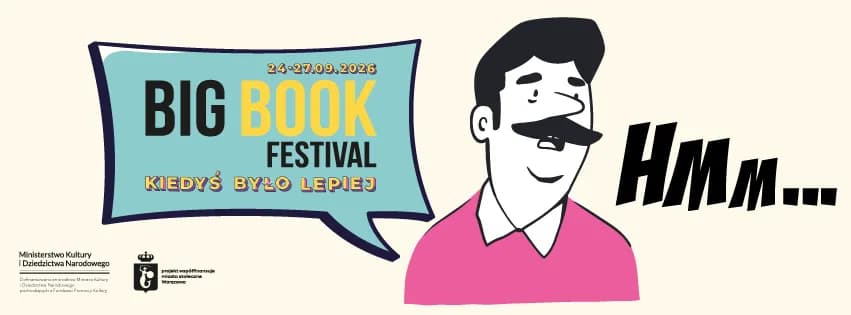
That tension is at the heart of this year’s Big Book Festival, which returns to Warsaw from 24 to 27 September with the deliberately provocative theme “Kiedyś było lepiej”, or “Things were better before”. Across four days, writers, artists and readers will look at what we remember, what we romanticise and what we may have conveniently forgotten.
The festival’s 14th edition ranges from family memories and generational differences to the legacy of the PRL, the transformation of the 1990s, ageing, changing cities and the rapid arrival of artificial intelligence. Rather than settling the question of whether the past really was better, the programme is interested in the much trickier question: which past are we talking about?
A festival about the past, without taking it at face value
The phrase “things were better before” is easy to say, but the festival organisers are interested in what people actually mean when they say it.
For some, it might mean childhood, slower routines or a neighbourhood that has disappeared. For others, it can point towards memories of a particular political or economic era. The programme also asks what has been lost in the rush towards modernisation, and whether some aspects of the past are now being romanticised by people who never experienced them.
The opening lecture, “Coraz trudniej tęsknić” (“It is becoming harder to feel nostalgia”), will be given by literary critic Prof. Przemysław Czapliński at Big Book Cafe MDM on Thursday, 24 September.
The festival will also bring together people from different generations. One of the more intriguing conversations pairs filmmaker and writer Filip Bajon with his son, writer and poet Kasper Bajon. Their Friday evening discussion will look at how age, changing social realities and artistic experience influence the way people view the past.
From PRL memories to the cities of tomorrow
The programme moves well beyond books themselves.
A Saturday discussion, “Co zyskaliśmy, co straciliśmy” (“What we gained, what we lost”), will look at the experience of Poland after 1989 and the memories surrounding the socialist period and the transformation that followed.
Elsewhere, historian Kamil Janicki will examine the roots of Polish identity, while journalist and author Michał Przeperski will revisit the turbulent 1990s and ask how that decade is remembered by the people who lived through it.
There is also plenty of room for contemporary concerns. Urbanist Magdalena Milert will discuss how technology is changing cities and whether the pursuit of increasingly “smart” urban spaces risks losing some of the qualities people value in older neighbourhoods.
Another conversation, with author Mateusz Łabuz, turns to artificial intelligence, deepfakes and the possibility that the digital transformation now underway may itself become the subject of future nostalgia.
International voices join the programme
The festival’s international strand brings writers from Britain, Norway and Romania to Warsaw.
British writer Jane Campbell, whose debut collection Cat Brushing was published after she turned 80, will discuss ageing, desire and the assumptions surrounding old age with writer Bartosz Sadulski.
Norwegian novelist Vigdis Hjorth will talk to philosopher and writer Mira Marcinów about memory, family and the difficult process of making peace with the past.
Romanian writer and anthropologist Raluca Nagy will discuss illness, identity and life between countries and languages with Aleksandra Zbroja.
The international programme also includes British novelist Louis de Bernières, whose work has repeatedly explored the way war and political upheaval shape individual lives and collective memory.
There is room for reading too
Not every event requires a panel discussion.
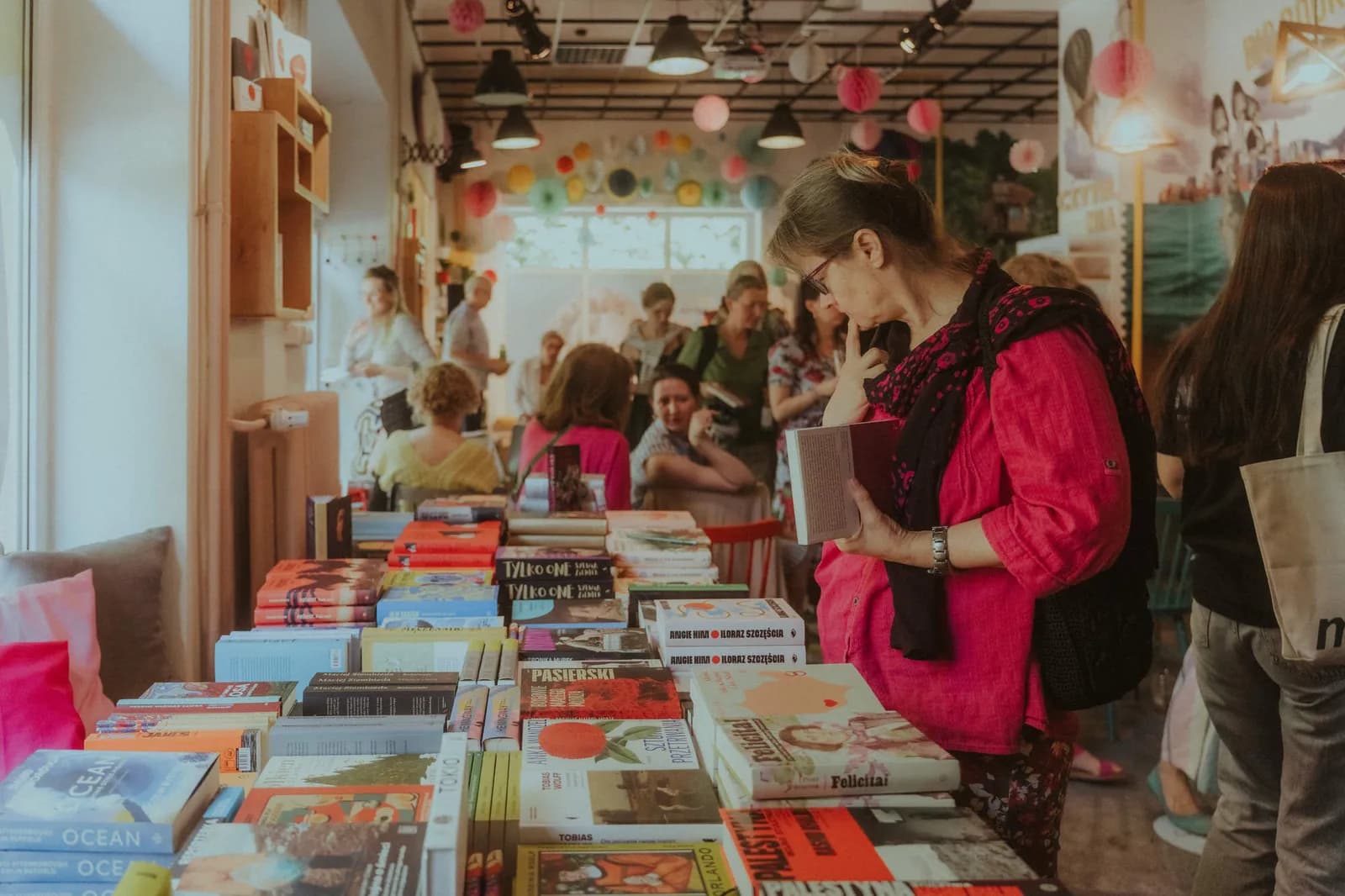
On Friday evening, Silent Friday will turn Big Book Cafe into a shared reading space. Visitors can bring their own book or choose one at the venue, settle down with a drink and read alongside other people for around an hour before talking about the experience afterwards.
The festival will also host Big Book Bazaar on 26 and 27 September, with second-hand books sold for symbolic prices between PLN 10 and 30. Proceeds will support the Foundation “Kultura nie boli” and its programme of free literary events.
For Warsaw readers, it is an appealingly simple idea: bring together people who like books, give them somewhere comfortable to sit, and let conversation take its own course.
Big Book Festival 2026: key details
When: 24 to 27 September 2026
Where: Big Book Cafe MDM, ul. Koszykowa 34/50, and Big Book Cafe Dąbrowskiego, ul. J. Dąbrowskiego 81, Warsaw
Admission: Free for the festival events, with some accompanying activities separately ticketed
Online: Festival events will also be streamed live and made available online afterwards.
The full programme is available through the festival website.
For Warsaw, a city where memories of radically different eras often sit side by side, the theme feels particularly appropriate. Big Book Festival does not offer a single answer to whether the past was better. Instead, it gives writers, readers and audiences a few days to work out what their own “before” actually means.
See more: Tilda Swinton – Ongoing Brings Four Decades of Creative Collaborations to Warsaw
Source and image credit: Big Book Festival