Few European capitals have a story as charming as Warszawa. Ask almost any Pole where the city's name comes from and you'll likely hear the tale of Wars and Sawa, a story of kindness, hospitality and life along the banks of the Vistula.
Yet behind the legend lies a different story, one rooted in language, medieval settlements and centuries of history. Together, these two accounts have shaped the identity of Poland's capital, blending fact with folklore in a way that continues to capture the imagination of residents and visitors alike.
The Historical Origins of Warszawa
The explanation favoured by historians is far less romantic, but no less interesting.
The name Warszawa is widely believed to have developed from the Old Polish personal name Warsz or Warsza, a shortened form of names such as Warcisław. The earliest settlement on the site was thought to belong to a man bearing this name, leading to forms such as Warszewa or Warszowa, meaning "Warsz's settlement".
Over the centuries, pronunciation and spelling gradually evolved into the modern name Warszawa.
Historical documents record several early versions, including Warszewa, Warszowa and the Latin form Varschevia, reflecting the way the city's name changed as Poland's language developed.
Although the identity of the original Warsz has been lost to history, linguists agree that the city's name almost certainly originated from a person rather than the legendary figures who appear in folklore.
The Legend of Wars and Sawa
The story most people know is very different.
According to one of Poland's best-loved legends, a humble fisherman named Wars lived beside the Vistula River with his wife, Sawa. One day, a prince, or in some versions a king, became lost while hunting in the forests surrounding the river.
Wars and Sawa welcomed the stranger into their modest home, sharing what little food they had and offering him shelter for the night. Touched by their generosity, the ruler rewarded the couple by granting them land and ordering that a settlement should be established there.
That settlement became known as Warszawa, combining the names of its kind-hearted hosts.
For generations, the tale has symbolised hospitality, generosity and the close relationship between the city and the Vistula, values that remain closely associated with Warsaw today.
The Warsaw Mermaid
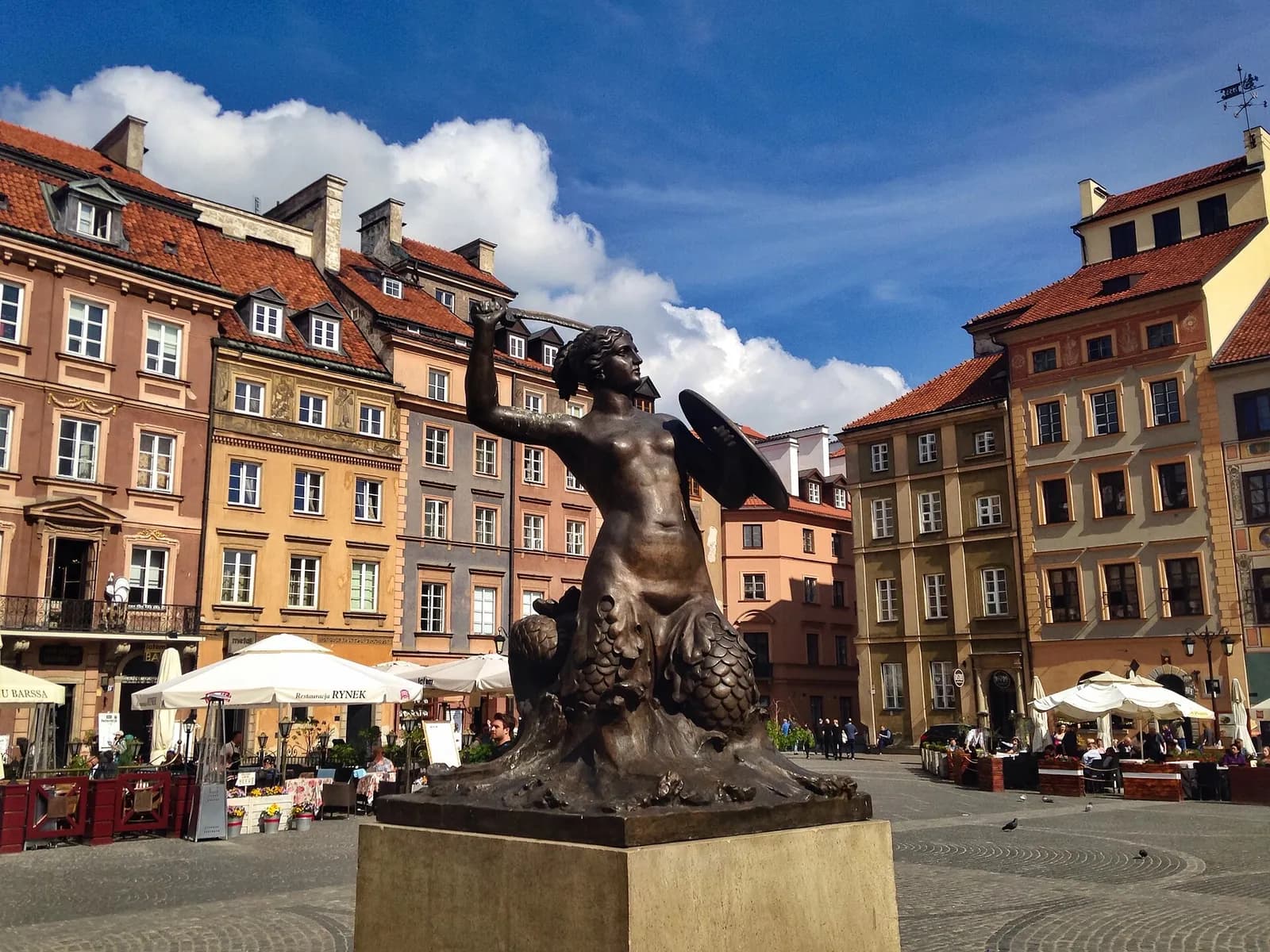
Another version of the legend introduces the city's most recognisable symbol, the Syrenka, or Warsaw Mermaid.
In this telling, Sawa is not a fisherman's wife but a beautiful mermaid living in the Vistula. She meets the fisherman Wars and the pair fall in love, giving rise to the name Warszawa.
The story also explains why the Syrenka became Warsaw's protector. Armed with a sword and shield, she is said to defend the city and its people against danger.
Today, the mermaid appears throughout Warsaw, from the famous statue in the Old Town Market Square to monuments along the Vistula Boulevards and the city's official coat of arms.
History and Folklore Side by Side
Modern historians draw a clear distinction between documented history and traditional folklore.
There is strong linguistic evidence that Warszawa developed from the name Warsz, while no historical records support the idea that the city was literally named after Wars and Sawa.
That, however, has done little to diminish the legend's popularity.
Like many of Europe's oldest cities, Warsaw has embraced both its documented past and its traditional stories. The legend continues to be shared in schools, museums, guided walking tours and family events, helping new generations connect with the city's heritage in a way that facts alone often cannot.
Rather than competing with history, the story of Wars and Sawa has become part of Warsaw's identity, reminding people that every great city is built not only on records and dates, but also on the stories its people choose to pass on.
image credit: Brian Dooley, Public Domain