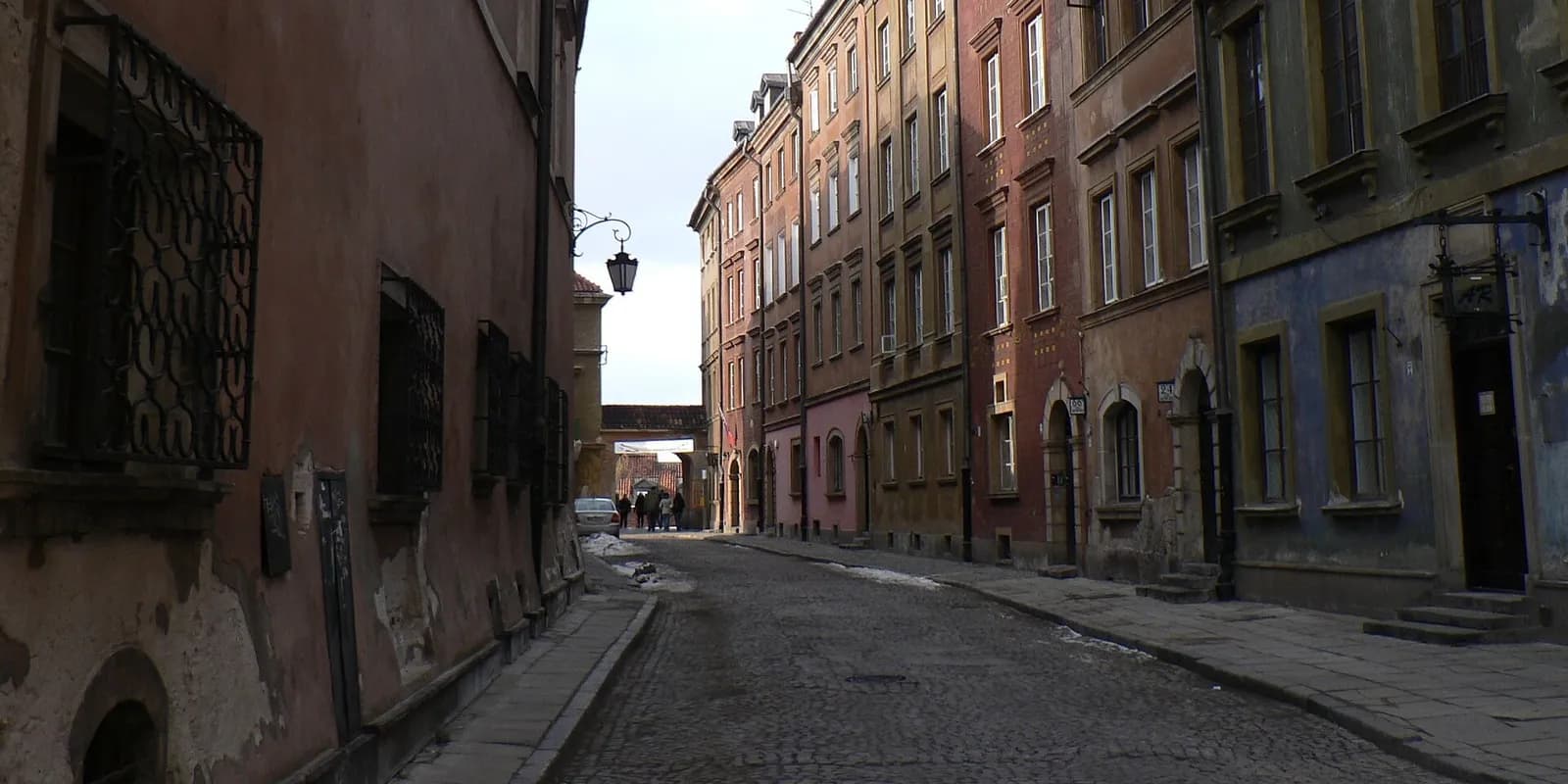
Walk through Warsaw’s Old Town and you will encounter plenty of familiar symbols: the Mermaid on the Market Square, colourful reconstructed townhouses and the narrow streets leading away from the Rynek.
But look closely around Krzywe Koło and another character from Warsaw’s folklore begins to emerge. It has scales, claws, a rooster-like head and, most dangerously of all, a deadly gaze.
This is Bazyliszek, the Warsaw Basilisk, one of the city's oldest and most enduring legends.
The story tells of a terrifying creature hiding beneath a ruined building in the Old Town. Anyone unfortunate enough to meet its eyes would die instantly. Yet the Basilisk had one weakness, and discovering it required rather more ingenuity than courage.
A monster in the cellar
The traditional story places the Basilisk beneath a ruined house around Krzywe Koło, a historic street in Warsaw's Old Town.
According to the legend, several children entered the cellar and disappeared. When people went looking for them, they encountered the creature responsible.
The Basilisk was said to resemble a strange mixture of serpent and bird, with a rooster-like head and a body covered in scales or feathers. Its most terrifying weapon was its gaze. Anyone who looked directly at it would be killed.
It sounds like a story designed to frighten children, but the tale has a surprisingly long paper trail.
The oldest known written version dates from 1739, when Antoni Chryzanty Łapczyński included an account of the Warsaw Basilisk in his work Majestat polski.... The story itself was presented as belonging to an earlier period, traditionally placed in the 16th century.
The exact date, however, is uncertain. Different versions give different years, including 1557 and 1587. These dates should therefore be treated as part of the legend rather than established historical events.
The prisoner with a mirror
The Basilisk's defeat is the cleverest part of the story.
After ordinary attempts to confront the creature had failed, a condemned prisoner named Jan Taurer was offered his freedom if he would enter the Basilisk's lair.
There was a catch. He could not look directly at the monster.
Taurer was covered in mirrors and sent into the cellar. When the Basilisk saw its own reflection, its deadly gaze was turned back upon itself.
The monster died.
The prisoner survived and, according to the story, earned his freedom.
It is a simple idea, but a memorable one. The Basilisk cannot be defeated by greater strength. Instead, its own power becomes its downfall.
The motif also connects the Warsaw legend with older European stories about deadly creatures destroyed through reflection, most famously the myth of Medusa.
From frightening monster to Warsaw icon
The Basilisk has changed considerably over the centuries.
Descriptions of the creature vary, but Polish depictions commonly give it features borrowed from both a rooster and a snake. Some versions have wings or feathers, while others make it look more like a reptilian dragon.
The literary tradition helped give Warsaw's Basilisk a more recognisable personality. Writer Artur Oppman included the creature in his collection Legendy warszawskie, helping establish the version of the story that generations of Polish children would encounter.
In Oppman's telling, the Basilisk becomes part of a more developed tale involving children, the dangerous cellar and the ingenious solution involving a mirror.
This is one reason it can be difficult to separate the "original" legend from the version familiar today. Warsaw's legends were passed from storyteller to storyteller, and writers continually reshaped them for new audiences.
Look for the Basilisk in the Old Town
There is no surviving cellar that can confidently be identified as the Basilisk's actual lair. The precise building described in the tradition is unknown.
The creature does, however, have a permanent place in the visual landscape of modern Warsaw.
On the façade at Rynek Starego Miasta 4, a post-war sgraffito shows the shoemaker confronting the Basilisk with his mirror.
It is an especially fitting place for the image.
Warsaw's Old Town was almost completely destroyed during the Second World War and subsequently reconstructed. The Basilisk decoration belongs to that remarkable process of rebuilding the historic centre and restoring a sense of continuity with the city's past.
So while the creature itself is imaginary, its image has become part of the very real story of Warsaw's reconstruction.
A legend you can still follow
The Basilisk is particularly easy to encounter on foot.
Start at Rynek Starego Miasta and wander towards Krzywe Koło. The streets are compact, and it does not take long to reach the locations associated with the story.
Look out for the Basilisk sgraffito at Rynek Starego Miasta 4, then continue through the surrounding streets and imagine the Old Town before its wartime destruction and reconstruction.
The Museum of Warsaw also includes the Basilisk among its Warsaw legends and uses the stories to explore the relationship between folklore, history and the city itself.
For families, it is an enjoyable way to turn an Old Town walk into a small treasure hunt. For anyone interested in Warsaw's history, there is another layer to discover: these legends survived not because every detail can be proven, but because successive generations continued to tell them.
The monster that refuses to disappear
The Warsaw Basilisk has travelled a long way from the dark cellar of the old legend.
Today, Bazyliszek appears in books, educational programmes, artwork and contemporary interpretations of Warsaw's folklore. Its image has become familiar enough that even a casual walk through the Old Town can reveal traces of the creature.
And perhaps that is the enduring appeal of the story.
Warsaw has been destroyed, rebuilt and transformed many times, but its legends have travelled with it. Somewhere beneath the colourful façades of the Old Town, at least in the imagination, the Basilisk is still waiting in the dark.
Just remember: don't look it in the eye.
See more: Meet the Traditions, Flavours and Sounds of Mazowsze in Warsaw
Image credit: Krzysztof Dudzik-Górnicki, Wikimedia Commons, CC BY-SA 3.0